921 People Came from India During the Pilkhana Killings
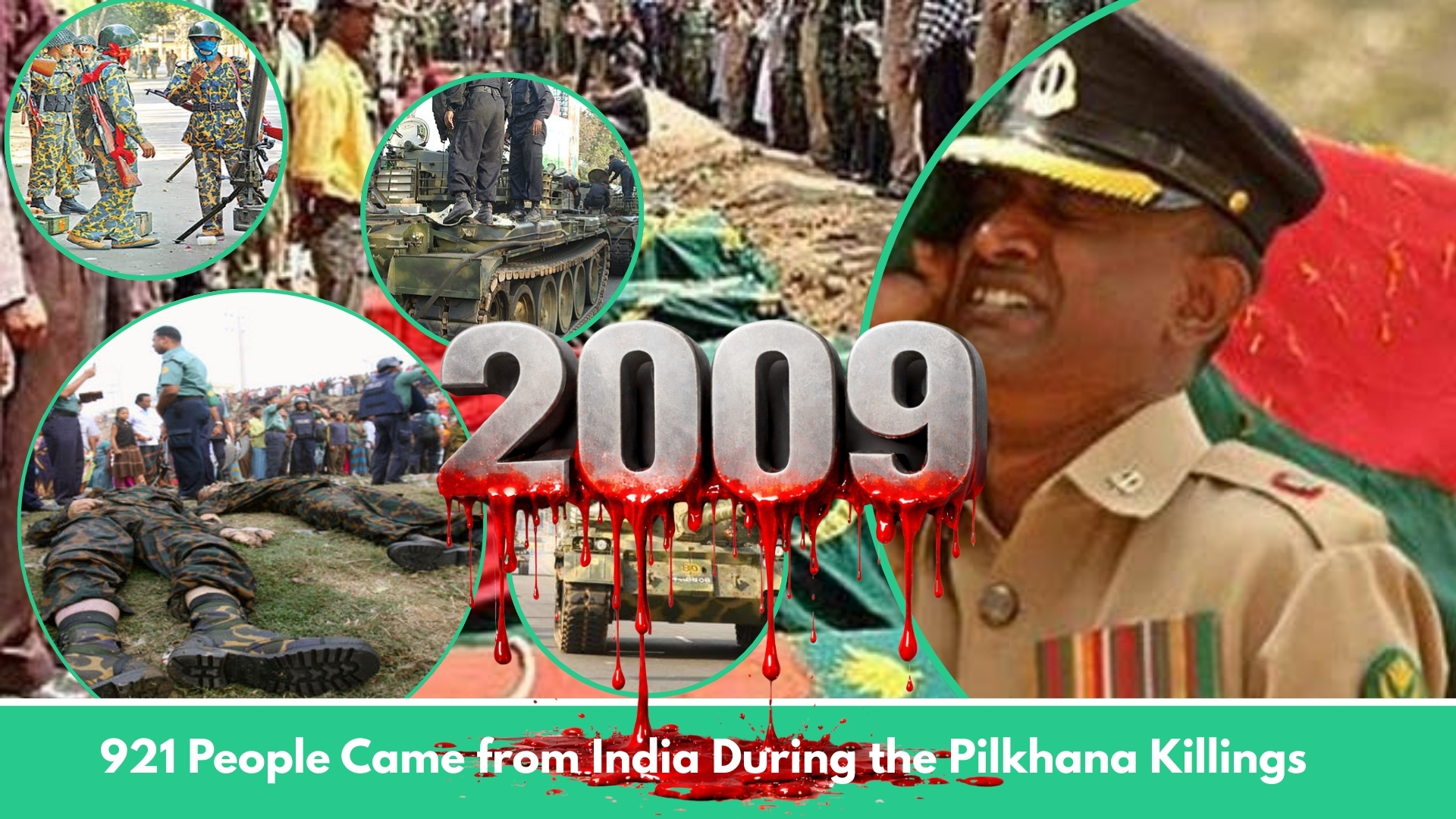
On the morning of 25 February 2009, at 9:00 AM, a meeting began at the Darbar Hall of the Bangladesh Rifles (BDR) headquarters in Pilkhana, located in the heart of the capital, Dhaka. During this time, one of the most horrific massacres in the country’s history took place.
Under the guise of a mutiny at the BDR headquarters, 57 army officers were brutally murdered, most of them along with their family members, meeting a blood-soaked fate. Within moments, the country’s military discipline, security structure, and morale collapsed. The nation stood stunned, watching the blood-stained Pilkhana in horror.This raised serious questions among the public: Was this a spontaneous mutiny, or a well-planned massacre?
From the very beginning, intense controversy arose regarding the role of the then Awami League government. Allegations emerged in various quarters that the government was deliberately negligent and slow in investigating the incident. There were even accusations that the massacre was part of a blueprint to weaken the country’s internal security system and establish Indian geopolitical influence by eliminating patriotic senior army officers.Although the truth of these allegations has been widely debated, over time the issues became more deeply rooted.
After the interim government came to power, a renewed investigation into the massacre began. On 30 November, the National Independent Investigation Commission, formed to probe this brutal massacre, submitted its report to the Chief Adviser, Professor Dr. Muhammad Yunus.
Investigating an incident that occurred 16 years ago was an enormous challenge. Evidence had been destroyed, witnesses had disappeared, and many documents were incomplete. Despite this, the commission—led by retired Major General ALM Fazlur Rahman—pieced together the shattered history of that horrific day.
The commission claims that it maintained the highest level of professionalism during the investigation. It listened to witness testimonies for hundreds of hours and collected old intelligence reports and investigation documents.
Commission Chairman Fazlur Rahman stated that the BDR mutiny was the result of a planned conspiracy. According to him, the objective was to destabilize the country, prolong Sheikh Hasina’s rule, and weaken both the Bangladesh Army and the BDR (now BGB).
He said that while there was some resentment among BDR members—such as issues related to the “Dal-Bhat” ration program and increased duties that went beyond their traditional roles—these grievances were used to provoke certain BDR members. The then government allegedly sought to extend its rule, while a neighboring country wanted to destabilize Bangladesh and weaken its armed forces. Therefore, this was a deliberate conspiracy to destabilize the nation.
The commission further claimed that the main coordinator of the incident was former Member of Parliament Sheikh Fazle Noor Taposh, and that the massacre occurred with the collective involvement of the Awami League and the “green signal” of what they described as the “fascist Sheikh Hasina.” The investigation also reportedly found Indian involvement.
Names mentioned at higher levels included former Prime Minister Sheikh Hasina, Barrister Fazle Noor Taposh, Sheikh Selim, Mirza Azam, Jahangir Kabir Nanak, Sahara Khatun, and several former senior military officials.
According to witness testimonies, Taposh allegedly held secret meetings inside a mosque at Pilkhana after offering prayers with DAD Touhid and some soldiers. Such meetings reportedly took place over a long period—after Friday prayers, at training grounds, and in offices—indicating that the conspiracy was not formed in a single day but over an extended time, culminating in the killings.
Witnesses also claimed that Taposh occasionally visited Pilkhana to seek votes and even came there on election day, urging soldiers and even a cleaner named Abdul Hakim to vote for the “Boat” symbol.
The report further stated that 921 Indian nationals entered Bangladesh during the BDR mutiny, many of whom could not be accounted for later. Intelligence sources, international writings, and witness testimonies suggested that India benefited the most from the outcome of the mutiny. As a result, the commission recommended that the government formally seek an explanation from India.
Additionally, witness testimonies mentioned that on 25 February, between 4:00 PM and 5:00 PM, a procession of around 20–25 people entered Pilkhana through the New Market gate, chanting slogans like “media and people are brothers.” They reportedly left again around the time of the Maghrib prayer.
Meanwhile, the BDR Welfare Council claimed that the killings were deliberately portrayed as a “BDR mutiny” by journalist Munni Saha, allegedly under government instruction. They argued that no army officers were killed outside Pilkhana.
Family members of the martyred army officers demanded exemplary punishment for what they called “traitorous” officers. They claimed that India had planned the killing of then BDR Director General Major General Shakil Ahmed, allegedly due to India’s defeat in the Roumari conflict.They stated that those who acted against brave soldiers and the army institution are still present within the army system today.
Protesters argued that the previous “fascist government” used the false “Dal-Bhat” issue as a cover to destroy Bangladesh’s sovereignty and armed forces, marking the beginning of authoritarian rule through this massacre. They demanded that all officers who betrayed and murdered the 57 army officers be brought to justice.
On Tuesday, a protest rally was held in front of the National Museum by “Manch 24,” demanding justice for the Pilkhana massacre and the swift execution of Sheikh Hasina’s verdict. Protesters openly accused India of being the main enemy responsible for destabilizing Bangladesh and called on people to stand against India’s alleged wrongdoing.They declared that every murder would be tried, and that Sheikh Hasina must be brought back to Bangladesh and executed.
When the Bangla Edition team spoke to members of the public, many said that such a massacre would not have been possible without Indian involvement. They held the then Hasina government fully responsible.Some citizens stated that such brutality could not have occurred without external forces, weapons, and provocation, calling the incident a planned conspiracy. Others said they did not support the government’s decisions at that time.
However, many accused individuals who have been brought under trial still believe that the real masterminds behind the massacre remain hidden.
Source : Bangla Edition
Disclaimer: This article is based on investigation reports, witness statements, and publicly available sources. The views expressed do not represent a legal verdict.
